

215 Coram Avenue
Shelton, CT 06484
203.710.3937

Expressive Therapies
What Children Can't Always Put Into Words
Art, play, and symbolic expression provide another way to understand a child's inner world.
Looking Beyond Words
Parents often learn a great deal from what their children say.
Sometimes they learn even more from what they don't.
Through art, play, sand tray, and storytelling, children often communicate thoughts, emotions, experiences, and patterns they cannot yet explain with words.
These expressions provide another way of understanding the child—not just the behavior.

Looking Beyond the Behavior
A child's behavior tells us something.
But it rarely tells us everything.
Anxiety.
Withdrawal.
Emotional outbursts.
Difficulty focusing.
Aggression.
These are often the behaviors adults notice first.
The more important question is what may be contributing to them.
Expressive therapies help reveal experiences, emotions, coping
patterns, and strengths that may not yet be expressed in words.
This is especially valuable for children with ADHD or autism, who may experience big emotions or communication challenges that are difficult to put into words, but come through clearly in art, play, or story.
STRENGTHS. IDENTITY. CONFIDENCE.
Strengths That
Deserve To Be Seen
Children are often defined by the challenges they're having.
Expressive therapies create opportunities to notice something equally important:
Curiosity.
Persistence.
Creativity.
Imagination.
Problem solving.
Resilience.
Confidence.
Recognizing these strengths helps build self-esteem while creating a more complete picture of the child.
More Than Art And Play
Art, play, storytelling, and sand tray are often viewed simply as therapeutic activities.
They are also valuable sources of clinical information.
Together with naturopathic medicine, they help Dr. Soalt better understand how a child experiences the world, processes emotions, responds to challenges, and expresses strengths that may otherwise go unnoticed.
This combined approach is available to families in Shelton, CT and throughout Fairfield County and Connecticut.
That deeper understanding helps guide a more individualized approach to care.
Expressive Therapy Approaches
Art Therapy
Drawing, painting, collage, and other creative processes provide children with another way to communicate, explore emotions, and make sense of their experiences.
Play Therapy
Play is a child's natural language. Through play, children often communicate thoughts, feelings, conflicts, and experiences that are difficult to put into words.
Sand Tray Therapy
Children create symbolic scenes using miniature figures and objects. These scenes often reveal experiences, concerns, perceptions, and strengths that may be difficult to express directly.
Storytelling & Creative Projects
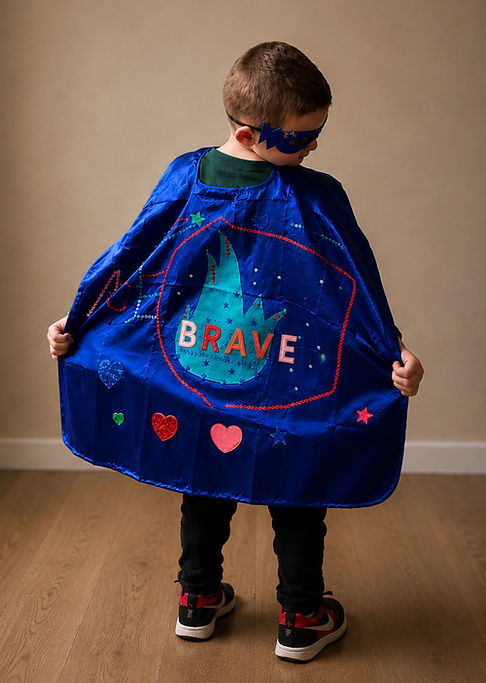
Stories, imaginative activities, and projects such as superhero capes provide opportunities for children to explore identity, develop coping skills, and recognize strengths that may otherwise go unnoticed.
Common Questions About Expressive Therapies
How is sand tray therapy different from regular play therapy?
Play therapy is broader and can include many kinds of imaginative or physical play, while sand tray therapy specifically uses miniature figures within a defined space to create a scene. The physical act of choosing, placing, and arranging objects often surfaces details a child might not reach through open-ended play alone — making it a useful complement to the other approaches described above.
What ages do expressive therapies work best for?
Expressive therapies can be adapted for a wide range of ages, from young children who communicate primarily through play to adolescents who may engage more through art, storytelling, or creative projects. The approach is tailored to how each child naturally expresses themselves.
Is this the same as traditional talk therapy?
Not exactly. While talk therapy relies primarily on verbal conversation, expressive therapies use art, play, sand tray, and storytelling as additional languages for children who may not yet have the words for what they're experiencing. Both can be valuable, and Dr. Soalt's approach often draws on expressive methods alongside naturopathic evaluation.
Can expressive therapies help if my child already has a diagnosis?
Yes. Expressive therapies are often especially useful for children with ADHD, autism, anxiety, or other diagnoses, since they can reveal coping patterns, strengths, and underlying experiences that standard evaluations may not capture.
Do you combine expressive therapies with naturopathic treatment?
Yes. Dr. Soalt integrates expressive therapies with naturopathic medicine to build a fuller picture of each child, combining what shows up in behavior and creative expression with what's happening physiologically.